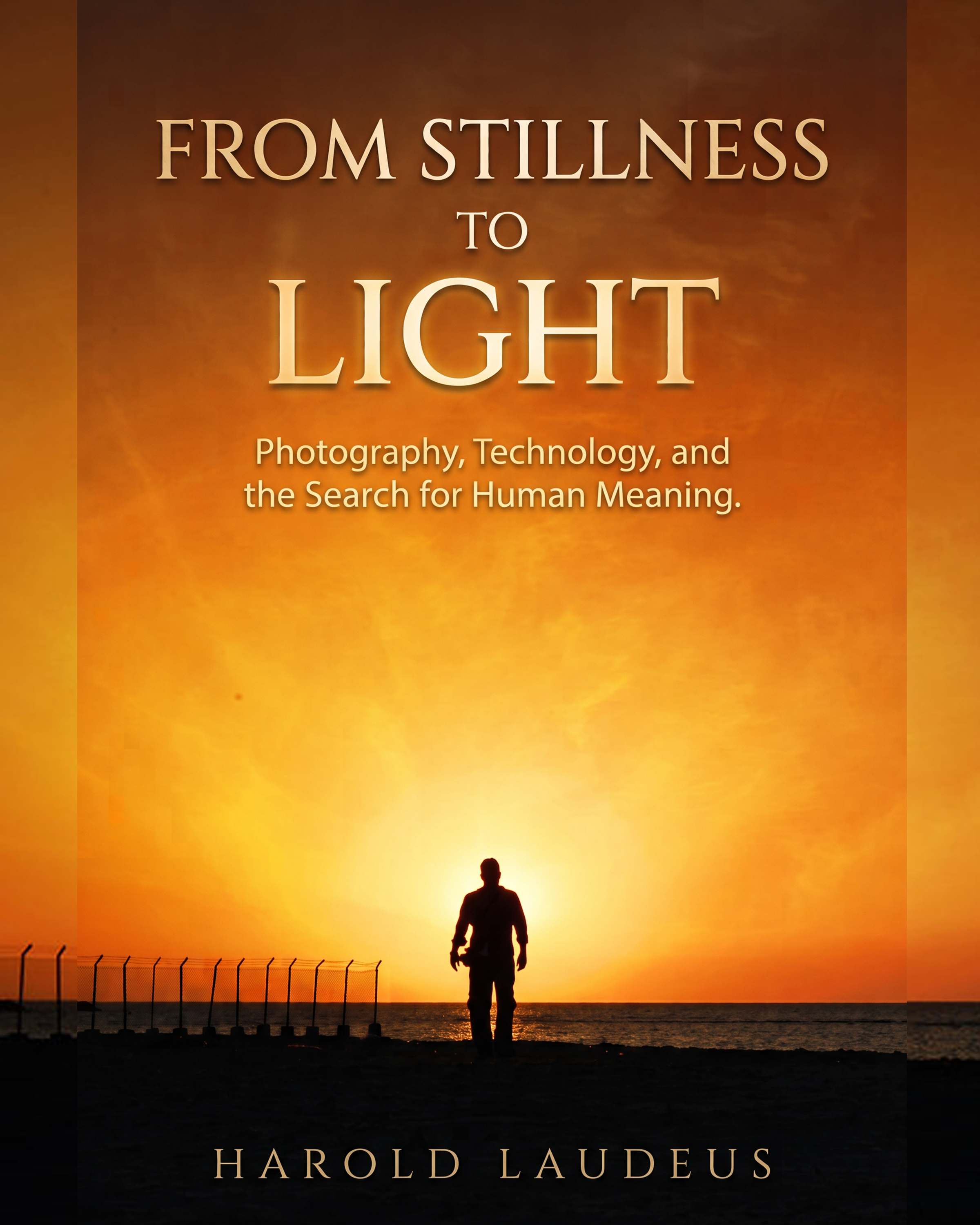
From Stillness to Light
Photography, Technology, and the Search for Human Meaning
A philosophical meditation on attention, memory, presence, and the Arché
Harold Laudeus
Technology professional, systems architect, photographer, and writer
London, Ontario, Canada
Copyright
From Stillness to Light
Photography, Technology, and the Search for Human Meaning
Copyright © 2026 Harold Laudeus. All rights reserved.
No part of this book may be reproduced, distributed, stored in a retrieval system, or transmitted in any form or by any means—electronic, mechanical, photocopying, recording, scanning, or otherwise—without prior written permission of the copyright holder, except for brief quotations in reviews, scholarly citation, and other uses permitted by applicable copyright law.
This is a work of philosophical reflection, personal memory, and creative nonfiction. The author’s recollections, interpretations, and conclusions are his own. This book does not purport to speak for the Order of the Holy Cross, the University of Santo Tomas, any educational institution, any employer, or any individual other than the author.
First ebook edition, 2026
Published independently by Harold Laudeus
London, Ontario, Canada
Author website: https://www.laudeus.ca
Cover photographs and interior photographs © 2026 Harold Laudeus. All rights reserved.
Front-cover photograph: Zallaq, Bahrain. Photograph by Harold Laudeus, made during a photowalk with friends.
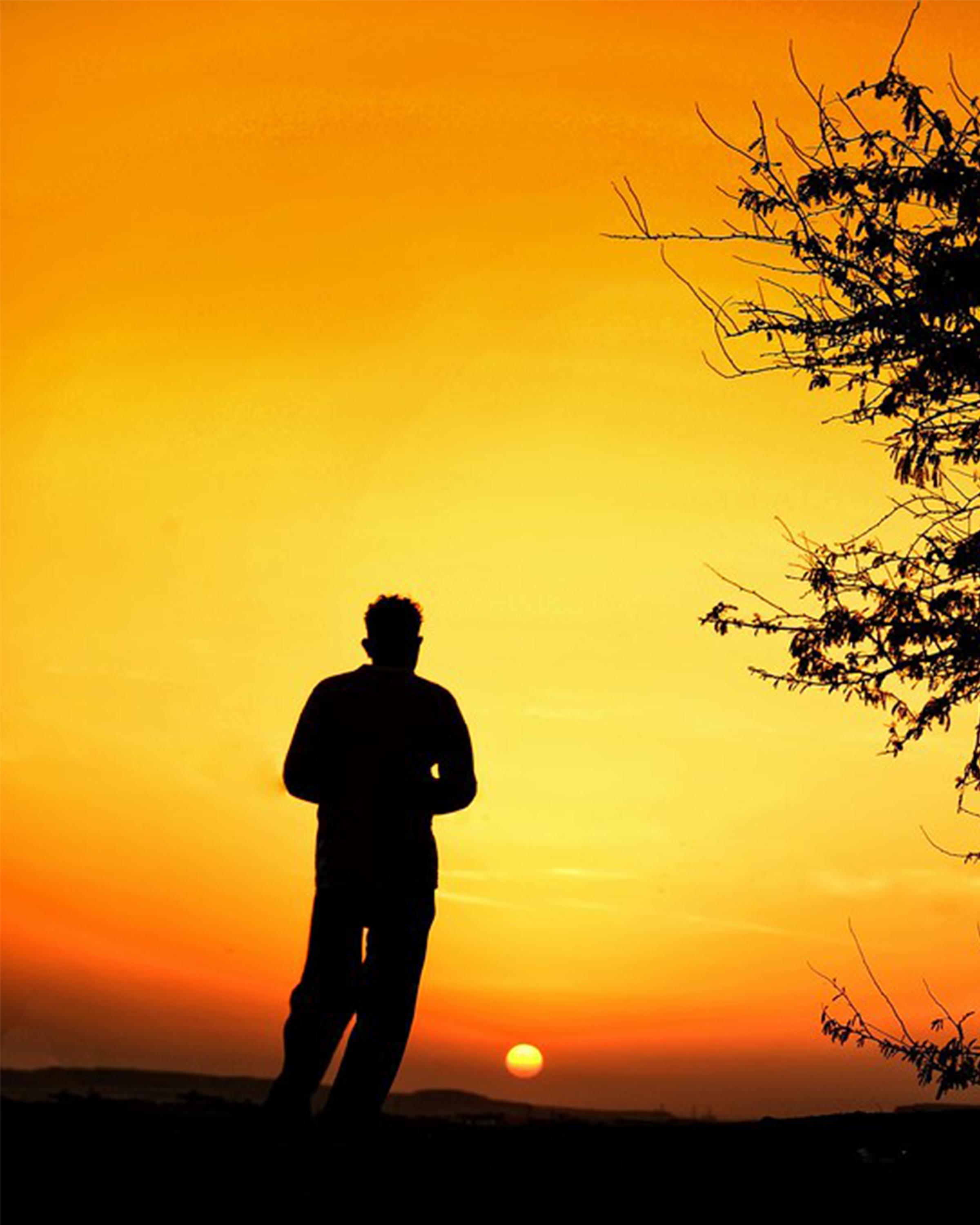
Back-cover photograph: Tree of Life, Bahrain. Photograph by Harold Laudeus, made during a sunset photowalk.
The cover photographs were recovered from the author’s historical Flickr archive. Their retained EXIF, IPTC, and XMP metadata identify HAROLD TEJADA—the author’s middle-name identity—as Artist, Creator, and By-line, and include a copyright notice naming Harold Laudeus and the author’s historical website.
Interior photographs:
Figure 1. Self-portrait at Candelaria Beach, Zambales, 1995.
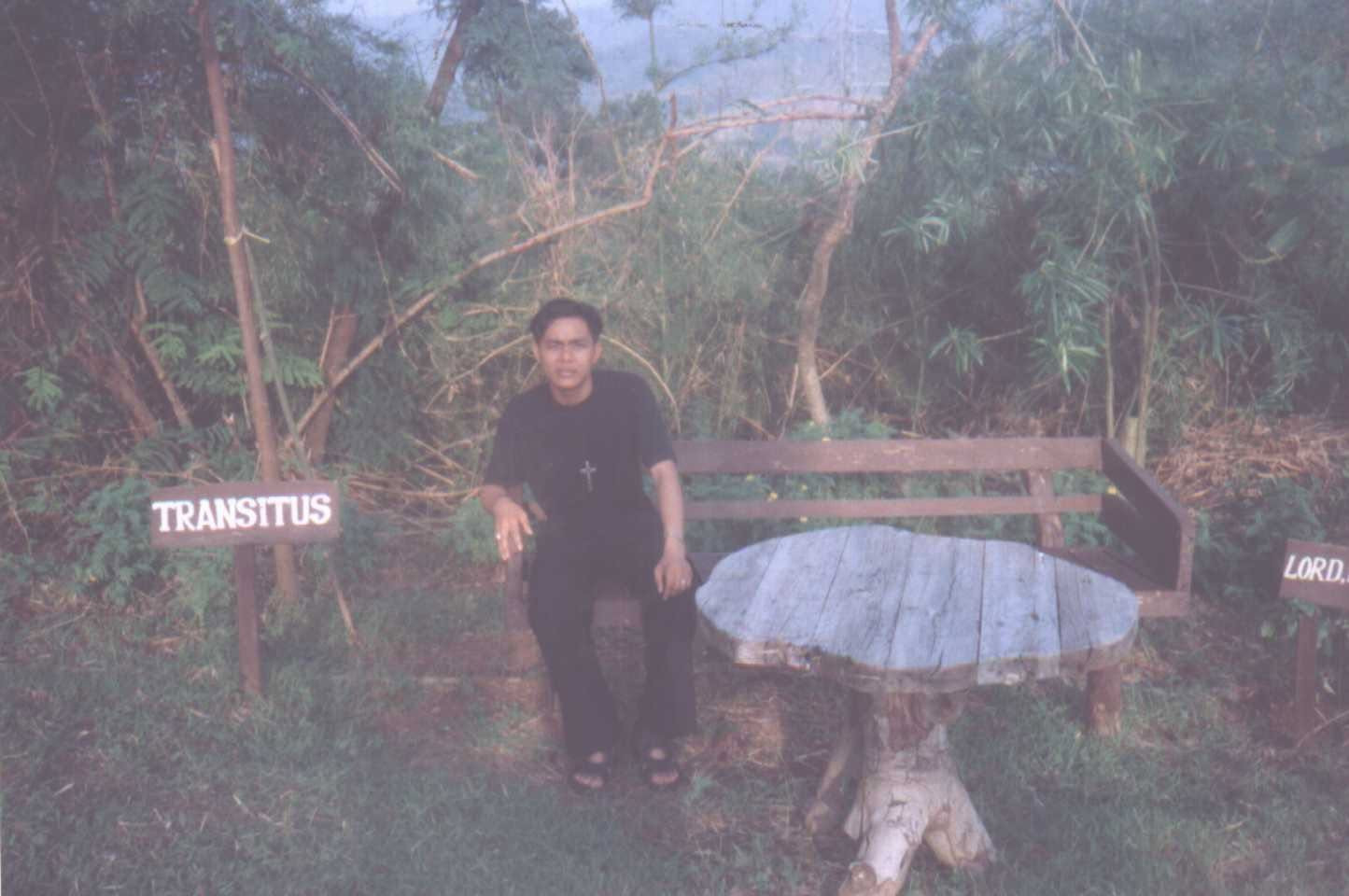
Figure 2. At the Transitus, Puso ng Carmelo, Damortis, La Union, 1995.
Photographs © Harold Laudeus.
Original camera files for the cover photographs are not currently located in the author’s active archive. The publication-ready cover files were downloaded from the author’s historical Flickr account, where the photographs were originally published.
Latin biblical text in the closing prayer: Numbers 6:24–26, traditional Vulgate wording; public domain.
Biblical quotation and translation references are included for source identification. The author’s arrangement, interpretation, and surrounding original prose are © 2026 Harold Laudeus.
Acknowledgements
This book was shaped by many forms of generosity: a gift, a question, a conversation, a remembered image, and the patience of people who allowed me to learn slowly.
My deepest gratitude is to my wife, Abigael, for her sacrifices, patience, understanding, and steadfast love. This book carries many years of questioning, searching, departure, return, and unfinished thought. Through all of it, her presence has given my life a form of steadiness that no philosophy or system can manufacture. Her love has reminded me that meaning is not found only in the images we preserve or the ideas we pursue, but in the persons with whom we are entrusted to share a life.
My first gratitude is also to my mother, who supported me in her own quiet ways during my working years in Quezon City and gave me a film camera. Long before I could describe photography as witness, memory, or a practice of attention, that gift gave me a way to pause before the world and try to keep an ordinary moment from disappearing. The camera travelled with me through different seasons of life, including my time in Candelaria, Zambales. Although the camera itself was eventually lost, the habit of looking that began with it remains.
I am grateful to the teachers, classmates, and intellectual communities that shaped my early formation in Baguio City and later at the University of Santo Tomas. Their questions helped make clear that conscience cannot be separated from reason, moral responsibility, or the difficult work of examining one’s commitments. The philosophers and ethical traditions that entered my life during those years did not give me a finished system. They gave me better questions, and the courage to continue asking them.
I acknowledge the years spent at St. Raphael Priory in Candelaria, Zambales, especially Fr. Thomas Jurgens, ORC, and Rev. Fr. Fidelis Stoekl, ORC; the Ordo Canonicorum Regularium Sanctae Crucis (ORC) and Opus Angelorum; and the places of formation that surrounded those years, including Puso ng Carmelo in Damortis, La Union. I also acknowledge Fr. Numeriano Gabot of the Shrine of Our Lady of Mount Carmel in Sison, Pangasinan. This book does not attempt to define these communities, settle their histories, or speak for their members. It records one person’s experience of vocation, formation, intellectual tension, departure, and the longer work of learning how to live honestly with unanswered questions.
My sincere appreciation goes to the Independent Order of Odd Fellows; the Grand Lodge of the Philippines, especially Most Worthy Grand Sire Ian Irving Bacungan, DDGS Mark Rillo, PG, and DDGS John Badillo, PG; the Grand Lodge of Ontario; Fortis and Fraternitas Odd Fellows Lodges; and my home lodge, Forest City Lodge No. 38 in London, Ontario, for their steadfast support and encouragement.
I am thankful to the friends, colleagues, teachers, and communities who have shared their time, stories, work, and presence with me. Photography is never only an individual act. Every meaningful image depends on a relation of trust: between the person behind the camera, the person or place before it, and the future viewer who receives what has been preserved.
My gratitude also extends to the engineers, technicians, archivists, librarians, photographers, writers, and makers whose work has taught me that technology can serve more than speed. Their work preserves voices, images, documents, relationships, and histories that might otherwise be lost.
Finally, I thank every person who has made me pause long enough to see more carefully. This book is an argument for stillness, but it was made possible by human presence: by friendship, love, truth, and the continuing grace of being given another chance to look.
Before the image, there is light.
Before the answer, there is attention.
Before the passage, there is stillness.
We do not possess what we truly see.
We receive it, keep faith with it,
and let it change us.
— HL
Author’s Introduction
This book began with photographs I did not know I was making for the future.
One was made on a beach in Candelaria, Zambales, in 1995. I placed a Ricoh film camera on a log, set the self-timer, and ran into the frame before the shutter opened. The horizon tilted because the camera was not level. I have left it that way.
Another photograph was made at Puso ng Carmelo in Damortis, La Union. I stood beside a sign marked TRANSITUS. At the time, it was simply part of the place where I was living and being formed. I did not know that the word—passage, crossing, the movement between one life and another—would later become a way of understanding my own story.
The pictures survived more faithfully than my explanations.
This book is not an autobiography in the conventional sense. It does not attempt to account for every year, settle every question, or turn every departure into a lesson. It is a meditation on what photography taught me slowly: that to see is not the same as to possess; that to preserve is not the same as to remember; and that technology, for all its power, cannot decide what a human life is worth.
I have worked for many years in telecommunications, enterprise systems, cloud infrastructure, web technology, and technical support. In that work, I learned to value reliability: the packet that arrives, the system that recovers, the archive that can be restored, the record that survives a failure. These are not small achievements. They allow people to speak across distance, families to keep images, organizations to preserve their work, and communities to remain connected.
Yet systems also taught me their limits.
A network can deliver an image without helping anyone receive it. A cloud account can store a lifetime of photographs without turning any of them into memory. A generated image can resemble a person or a place without having entered into relation with either. Provenance technologies can document information about an image’s origin and changes, but provenance itself does not decide whether a person has been treated with dignity.
The question running through these pages is therefore not whether technology is good or bad. It is more difficult:
What kind of person do we become when our tools make it possible to record, reproduce, distribute, and generate almost anything?
The answer cannot be found in a device alone. It requires attention, restraint, memory, consent, and the willingness to remain answerable to what is real.
Three values guide this book: Friendship, Love, and Truth.
Friendship is the refusal to treat another person as material. It asks us to recognize that a face exceeds the frame, that a story exceeds its usefulness, and that no person becomes an object simply because a camera can see them.
Love is the practice of remaining. It is the patience to stay with what matters when speed, novelty, and convenience ask us to move on. It is the decision to keep faith with people, memories, and questions that cannot be resolved quickly.
Truth is fidelity. It does not mean untouched pixels, perfect recall, or the fantasy of total certainty. It means naming an image honestly, admitting what has been changed, preserving what is private, and refusing to claim an encounter that never happened.
These values are not offered as a system that can remove ambiguity from a life. They are offered as disciplines for living inside ambiguity without surrendering to it.
The ethical question I learned from Kant remains with me: what rule am I making for myself, and could I defend that rule if everyone followed it? Kant’s moral philosophy treats the categorical imperative as a standard of rational obligation rather than a matter of personal preference. In this book, the question becomes practical: Could I defend the rule behind this photograph? Could I defend the rule behind this archive, this caption, this edit, this public disclosure, or this use of artificial intelligence?
The book does not ask readers to return to an imaginary past before the internet, cloud storage, social media, or generative systems. We cannot return there. Nor should we deny the genuine goods technology makes possible.
It asks instead for a more demanding kind of progress: one in which our systems remain accountable to human relationship.
A personal archive is not merely a hard drive. It is a decision about what deserves a name, a date, a context, a second copy, and sometimes a private boundary. Institutions concerned with digital preservation emphasize that long-term access depends not only on storage but also on technical quality, metadata, formats, and documentation. The language may sound technical, but its human meaning is simple: someone must care enough to make the future possible.
The same is true of photographs.
An image can be a record, but it can also be an interruption. It can ask us to stop treating the world as a supply of content. It can make room for a person to remain larger than the story we want to tell about them. It can remind us that the most important things in a life are often not the loudest, fastest, or most shareable.
This is why the book moves from stillness to attention, from attention to witness, from witness to custody, and from custody toward truth and light.
The word light in these pages does not mean a perfect answer. It does not mean escape from grief, doubt, technology, or history. It means the condition in which we become able to see more truthfully. Light does not belong to the photographer, the machine, or the writer. It arrives. We receive it. Then we decide what kind of persons we will be when it does.
I offer this book to photographers, technologists, archivists, readers, and anyone who has felt that modern life has made it difficult to remain present inside their own memories.
Read it slowly.
Keep what is true.
Let the horizon remain crooked when crooked is the truth.
And when you reach a threshold you cannot yet understand, do not assume that you have failed.
You may be standing at the beginning of a passage.
Table of Contents
- Prelude
- 1. A Note Before the Light: The Threshold of Seeing8
- Part I: Stillness
- 2. Leaving the Frame: 19979
- 3. The Velocity of Images11
- Part II: Attention
- 4. Photography as Resistance: The Discipline of Attention12
- 5. Portraits of Presence: Dignity, Encounter, and the Other13
- Part III: Memory and Technology
- 6. Technology in Service of Memory: Systems, Cloud, and Care14
- 7. The Tools We Choose: Algorithms, Artificial Intelligence, and Truth16
- Part IV: Light and Truth
- 8. Light as Witness: The Arché and the Receptive Eye18
- 9. The Light That Remains: Essence, Beauty, and Benediction19
- Closing Materials
- 10. A Practice for Seeing: Seven-Day Field Manual and Reflection Rhythm21
- 11. Truth and the Departure to Light23
- Coda I
- 12. Transitus: Toward the Light25
- Coda II
- 13. Arrival to Self26
- Blessing
- Oremus28
- Back Matter
- 14. About the Author29
- 15. Contributor Notes30
- 16. Back Cover Blurb31
PRELUDE
01. A Note Before the Light: The Threshold of Seeing
You have arrived at a threshold, not an argument. Before the essays begin, pause. The pages that follow move at the pace of light entering an unlit room: gradually, and then all at once.
This book is for anyone who makes images, keeps them, or builds the systems that move them: the photographer who feels late to their own life, the archivist drowning in files, the technologist who can keep a network alive and still lose a family story. It is concerned with cameras, but it is not confined to optics. It asks what becomes of attention when we can record everything and inhabit almost nothing.
The central question is not whether the still photograph can survive an algorithmic culture. It is whether the still image has become indispensable because of it.
When transmission speeds multiply, prolonged attention becomes a deliberate act. When streams refresh without end, a single photograph can restore the weight of one unrepeatable moment. The camera does not solve the mystery of the world. It offers a quiet ground from which to behold it.
Beneath these reflections lies an older question: what gives an encounter its coherence? The Greek word Arché names an origin, a first principle, a ground from which form and meaning arise. In this book the Arché is not a secret hidden behind appearances, and it is not something a sharper sensor can expose. It is the deeper order toward which unhurried attention turns: the sense that a face, a gesture, a shoreline, or a slant of dawn light holds more reality than use alone can exhaust.
Photography cannot possess that order. It can only approach it. An image becomes meaningful not when it claims to own reality, but when it leaves reality more available: more present, more complex, and more worthy of care.
Four movements shape the looking that follows.
- Stillness is the pause before perception, the refusal of visual greed.
- Attention is the ethical act of giving oneself to what is present, without first asking what it is for.
- Witness is the promise to safeguard what has shown itself.
- Practice is the daily return to presence, memory, and stewardship.
These movements are governed by three principles: Friendship, Love, and Truth.
Friendship refuses to reduce another being to an instrument, an audience, or an asset. Love abides with what matters when convenience calls us onward. Truth looks beneath the surface without fleeing the material world.
Every discipline of seeing has a history. Mine begins with a beach in Candelaria, an imperfect horizon, and the years in which I tried to exchange a camera for certainty.
PART I · STILLNESS
02. Leaving the Frame: 1997
In 1997 I was alone in Manila, newly sent out from the priory in Candelaria, Zambales. I could not continue as a seminarian in the Order of the Holy Cross. The sentence was plain. The life inside it was not.
I had come to the priory with a life already behind me. Before Zambales, I had worked in Quezon City. My mother gave me a Ricoh camera during those years, before I decided to enter religious formation. It was not yet a symbol or a philosophy. It was a gift: a way of looking that I had not learned to explain.
I took the Ricoh with me to Candelaria. It was a film camera, and film was a discipline I could barely afford. I made photographs at the priory, but not many. I did not have the freedom, or the money, to buy what the camera required, not even for developing. A roll of film made every frame a decision. I could look more often than I could afford to keep what I saw.
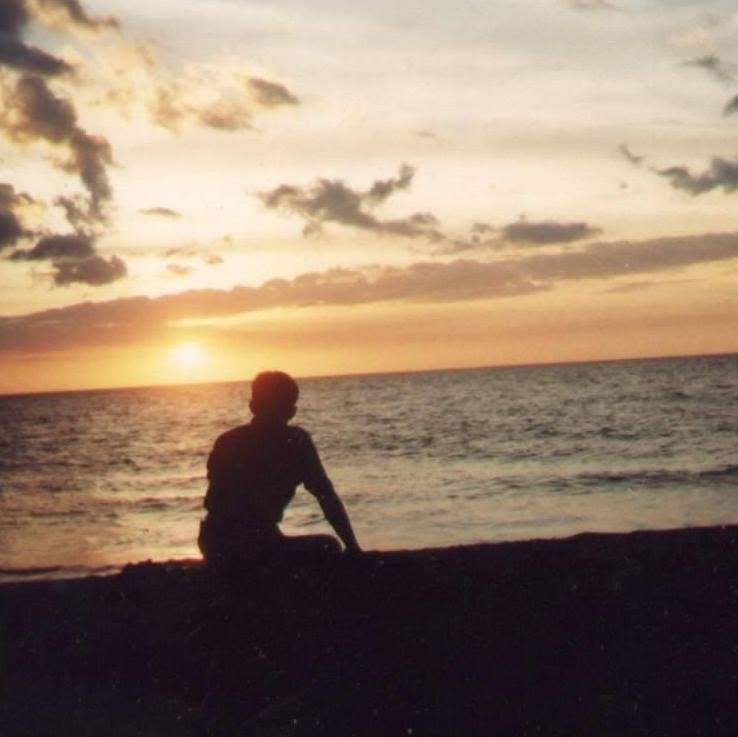
One frame remains. In 1995, while I was an intern at the priory, I made a self-portrait on the beach at Candelaria. I had no tripod. I placed the Ricoh on a log near the shore, set the self-timer, and ran across the sand before the shutter opened. The horizon tilts because the camera was not level. I did not correct it then, and I would not correct it now.
At the time, I was not making a statement about solitude, vocation, or departure. I wanted to remember an evening: the low sun, the water, the brief fact of being there. Yet the image holds the conditions of its making: limited means, improvisation, and the small urgency of getting into the frame before time ran out. It is not a picture of perfection. It is a picture of someone trying to be present in his own life.
But the harder problem was not the camera. It was the life I had entered.
I had questions the house could not answer to my satisfaction. They were not small doubts about a schedule or a custom. They went to the ground. I wanted reasons for the commitments I was being asked to make. At the time, I experienced the Order’s tradition as an answer given before my questions had been allowed to become fully articulate. I feared that obedience would require the surrender of the very faculty I believed conscience depended on.
Those questions did not begin at Candelaria. Before I went to Zambales for my internship, I had encountered different intellectual influences while I was in Baguio City. I was reading Ayn Rand, thinking through situation ethics, and trying to understand the demands of Kant. I did not treat these as one philosophy. They gave me different, and not always compatible, ways of naming what troubled me.
One lesson stayed with me because a professor made us memorize it as an impossible-looking acronym: AOOTMWYCATSTWTBAUL. It stood for a sentence from Immanuel Kant: “Act only on that maxim which you can at the same time will to become a universal law.”
The acronym was awkward enough to be memorable. The question behind it was not. Before I acted, Kant required me to ask what principle I was actually choosing. Could I will it for everyone, or did I want an exception merely because the action served me? The sentence made morality feel less like obedience to an external command and more like a demand that my own reasons be capable of public honesty. It asked whether I could live under the rule I was prepared to impose.
I carried that question with me to Candelaria. The priory did not create my intellectual restlessness, but it made its consequences impossible to postpone. Kant’s discipline of universality stood beside a more personal moral pressure: the recognition that no one should offer a vow he cannot sincerely will as a pattern for a life.
Rand gave me a language for intellectual independence and for the refusal to call contradiction a virtue. I was drawn to her demand that reason should not be sacrificed to authority merely because authority had inherited a sacred name. Situation ethics gave me a different intuition: that a moral act cannot be judged without regard for the person, the circumstance, and the human cost of a rule. I was drawn to the sense that one cannot judge a life from a rule alone without attending to the particular person and the consequences of obedience.
I had not reconciled these ideas. Kant asked whether I could will a principle universally. Situation ethics asked what the person, circumstance, and human consequence required here. Rand asked whether I was abandoning my mind to an authority I had not justified. I was young, restless, and certain that any answer requiring the silencing of my questions could not be true.
I was not only disputing ideas. I was also confronting the distance between a vocation’s demand for wholeness and my inability to give myself wholly to it. The conflict was private, but it made pretence impossible. I could not ask an institution to accept a promise I could not honestly make.
The Order did not fail because it could not become the form of life I wanted. A religious community is not a private philosophy assembled around one person’s needs. Its charism asks for a kind of assent, obedience, and common life that I could not honestly inhabit. I had reached its boundary, and it had reached mine. When a seminarian’s governing ideas cannot live within that form, the house must let him go or cease to be itself. I was sent out.
What I felt in Manila was not the triumph of reason. It was exposure. I had rejected a life whose answers I could not accept, but I had not yet learned how to live with questions that could not be solved by refusal. I had begun philosophy at the University of Santo Tomas, so the questions had a classroom. They did not yet have a home. What is a person for? What may one love without lying? What remains when a promised form of life is closed?
I can now see the limitation in my certainty. Reason can become dogmatic when it imagines that only what it can master deserves assent. I was right to refuse pretence. I was not yet wise enough to understand that questions need more than victory; they need a form of life capable of carrying them. I was not yet able to distinguish intellectual honesty from the need to master every question before I allowed it to matter.
The film camera went with me to Manila. I used it seldom, but I did use it. During my philosophy studies at the Ecclesiastical Faculties of the University of Santo Tomas, I made photographs with people I met and cared for. They were not assignments. They were small acts of keeping: a face, a shared afternoon, a person who mattered in a season when I had lost the form of life I thought I would live.
I do not know where the Ricoh is now. I kept it through Candelaria and Manila, used it sparingly, and then, at some point, it was gone. Not surrendered, returned, or deliberately given away. Lost. It was my mother’s gift, and I did not protect it well enough to keep it. The images were few. Some may also be gone. But the Candelaria frame remains: an evening on the shore, made before I understood how much of a life can disappear and how much one imperfect photograph can still hold.
After leaving the priory, I stopped using the camera as my principal instrument. With the help of a friend, I bought computer parts in Greenhills and began to assemble a machine. Board, memory, disk, power. A computer offered a different kind of certainty. It either started or it did not. There was no developer to buy, no roll to wait for, no shop charge I could not meet.
That unresolved condition shaped the life that followed. Technology gave me systems I could build, diagnose, and repair. I did not understand then that I was changing instruments rather than changing my question. In the priory I had tried to order a life. At a table in Manila I learned how parts become a system. Both were disciplines of attention. One I had not been able to keep. The other I could hold in my hands, and so I followed it.
Transitus: The Passage Between Frames
I did not have this word for my life in 1997, but I had stood beside it before: transitus.
In 1995, at Puso ng Carmelo in Damortis, La Union, I made a photograph of myself standing beside a sign marked TRANSITUS. I was still in formation. Behind me were trees, a bench, and the ordinary quiet of a religious place. I did not know then that the word would later return as a way of understanding the years to come. I was not performing a prophecy. I was simply standing beside a sign.
Yet photographs keep meanings that the photographer does not yet possess. The image does not prove that I knew I would leave Candelaria, enter Manila alone, or turn toward the systems of technology. It preserves something more modest and more truthful: I was already near a threshold, even if I could not name the crossing ahead.
Transitus means passage, crossing, or going through. In Christian usage it can name a passage through death into life—not only an ending, but a crossing that cannot be understood while one is still standing on the threshold. Here I use the word more broadly, but not casually. It names the period in which one way of inhabiting the world has become impossible while the next way has not yet revealed its form.
Leaving the priory was such a passage. I did not leave with a finished philosophy, a new vocation, or an answer that made the loss clean. I left with questions, a camera I used only sparingly, a mind trained to demand reasons, and a life that had to become practical before it could become intelligible.
The Ricoh belonged to the first side of that crossing. It had been my mother’s gift. It travelled with me to Candelaria and then to Manila. It taught me scarcity: that every frame costs, that not every moment can be claimed, and that an image may have to wait before it becomes visible. The computer I began to assemble in Greenhills belonged to the other side. Its parts were available to the hand: board, memory, disk, power. A machine either began or it did not. It offered a form of certainty at a time when the larger shape of my life did not.
But a passage does not erase what preceded it. The old instrument remains inside the new life, even when it is no longer in the hand. I did not stop wanting to remember. I did not stop being moved by light. I simply learned to make systems before I learned how to return to the image.
This is why I do not understand transitus as a clean conversion from one identity into another. It is a discipline of carrying. The person who crosses is changed, but not emptied. The questions cross. The gifts cross. The unfinished grief crosses. Even the tilted horizon crosses.
Years later, photography returned to me not as a rejection of technology, nor as a rejection of the years that followed Candelaria. It returned as a way of receiving what neither institutional certainty nor technical mastery could provide: the visible world, another person’s presence, and the moment that asks to be met before it is understood.
The passage, then, was not from religion to technology, or from camera to computer, or from doubt to resolution. It was from one way of seeing to another. I had to lose the belief that every meaningful life would arrive as a complete answer. Only then could I begin to understand stillness—not as withdrawal, but as the courage to remain at the threshold long enough for light to change what it reveals.
Outside that private rupture, another kind of future was already gathering force. Pagers vibrated against belts. Handsets grew lighter. Dial-up modems sang their electronic handshake into the dark. The phrase Information Superhighway moved through newsrooms and boardrooms as if connection itself were a moral good. The culture was learning not only to communicate, but to refresh.
Speed was becoming a kind of virtue. A still photograph could not update itself, ping, or prove that I was keeping up. The camera could only say: here, once, under this light. I was not ready to hear a sentence that quiet. I wanted a machine that answered.
That decision began a career in telecommunications, networks, enterprise systems, and digital infrastructure. Photography, much later, returned me to what I could not master: light, another person’s presence, and a moment that must be received before it can be understood. The next chapter names the condition that made speed feel like salvation.
03. The Velocity of Images
Photography was once governed by scarcity. A roll of 35mm film held twenty-four or thirty-six frames. Each press of the shutter had a cost in money, chemistry, and time. You measured the light, checked the edges, and held your breath.
Between exposure and proof there was a delay: tank, wash, drying line. In that interval, memory did its work. The picture was not yet a post. It was a promise you had to wait for.
Today, capture has been cut loose from consequence. Sensors sit in pockets, dashboards, doorbells, watches, and street poles. We make more pictures in a day than a working photographer of the last century could make in a career. Abundance has not produced clarity. A river in flood will not let you drink.
The crisis is not volume alone. It is velocity.
A digital image is often born already in circulation. Feeds are built to extract a fraction of a second of attention and then replace the picture with the next one. We confuse being seen widely with being seen well. A photograph viewed two million times may never once be received. Circulation is not discernment.
Consider an ordinary birthday. Forty frames leave the phone before the candles are blown out. The burst is a kind of insurance: if I have the file, I must have been there. Later, the album is a blur of nearly identical faces, none of them chosen. The person who was in the room spent the song managing the frame. The camera did its job. Presence did not.
That is the core paradox. Our devices let us record every hour while inhabiting almost none of them. When every experience must be captured to prove it occurred, the camera stops being an instrument of perception and becomes an engine of estrangement.
An image can be everywhere and still be unseen. Treated as content, it loses context. We document gatherings, meals, and milestones, then wonder why memory feels thin. The archive swells. Meaning does not. We have not lost our photographs. We have lost the unhurried time that makes them ours.
The still photograph’s radical virtue is that it refuses to move. It does not compete with the clip or the live stream. It interrupts: this, here, under this sky. It asks us to inhabit duration again.
Refusal is not enough. Someone still has to learn how to look. That discipline is the subject of the next part.
PART II · ATTENTION
04. Photography as Resistance: The Discipline of Attention
There is a way of looking that does not begin with a brief. It seeks no approval and compiles no metrics. It begins with the willingness to remain.
Older traditions called this devotion: not a mood, but a loyal return. I use the word carefully. Attention is the architecture of love before it is a style. Before we can care for a person, keep a community, or make work that lasts, we have to notice what is actually there. Attention is an ethical obligation before it is a craft.
To make an honest photograph is to consent to interruption. We say we “take” a picture. Honest seeing is closer to receiving. The shutter does not conquer the scene. It admits that something unscripted has offered itself: dawn on a scarred table, an elder’s knuckles, a child paused in a doorway. These are not assets. They are occasions.
The difference is practical, not only moral.
| Conquest | Reception |
|---|---|
| “Taking” the picture | Letting the light arrive |
| Speed, utility, extraction | Patience, dignity, witness |
| The picture serves the feed | The picture serves the encounter |
Interruption is rarely convenient. It comes when we are late. To stop is a small death of efficiency. Love begins near that death, where usefulness no longer leads.
Often I carry a manual camera through London, Ontario, for hours and make no exposure. This is not failure. It is the refusal of visual greed. The urge to photograph everything can be a soft form of ownership: an attempt to consume an experience before it has addressed us.
A test helps. Before the shutter, ask three questions. Am I afraid this will vanish if I do not own a file of it? Would I still be glad I stopped if the frame were poor? Can I name what I am receiving, in one plain sentence, without a caption’s help? If I cannot, I keep walking. The walk is the practice. The picture, when it comes, is the residue.
When we decline to turn every encounter into evidence, we are finally allowed to behold it. The hardest form of that beholding is another person’s face.
05. Portraits of Presence: Dignity, Encounter, and the Other
The ethical test of a picture is not a theory of beauty. It is a living face.
A likeness can be taken in a fraction of a second. Machines do this all day without care. A portrait is different. It is an encounter negotiated before the shutter moves. Someone trusts you with minutes of a life, not because your lens is sharp, but because being seen seems worth the risk of being misunderstood.
Friendship is the compass here. Not familiarity, and not the warmth of networking. Friendship is the decision to meet another person without reducing them to their use, their role, or their agreement with you. It honors the fact that the other remains other.
The person in front of the lens is larger than the frame. Ancestry, joy, grief, and dignity do not fit inside the border. A good portrait knows this and does not pretend otherwise. That is why a picture of hands can be more truthful than a bright close-up that hunts the eyes. Hands on work trousers, hands around a chipped mug, hands quiet at an elder’s side: the face may turn away, and the person is still there.
Dignity is not a lighting recipe. It is what happens when a person is not collapsed into the image made of them.
In the field, friendship has a sequence. It is ordinary, and it is the whole ethic.
- Say what you are doing, in plain speech, before you raise the camera.
- Ask whether this moment is theirs to give. A public street is not the same as a kitchen, a hospital corridor, or a child.
- Show the frame. On a phone, turn the screen. On a film camera, describe what you saw and offer to stop.
- Leave a way out. “I can put this away” is part of the portrait, not a courtesy added later.
- When you edit, ask whether you are clarifying the encounter or recruiting the person for a mood you needed.
A further question belongs here: could I will the rule behind my photograph as a rule for everyone? If every photographer treated a stranger’s grief, exhaustion, or vulnerability as material for attention, would the human world become more truthful or less safe? The question does not replace consent. It sharpens it. It tests whether an image is an exception I grant myself or a practice I could defend in public.
Consent on a form may matter for publication. It is not the same thing as consent in the room. A signature can permit use. It cannot create a relation that was never there. If you photograph in public, the law of a place may allow the frame and still leave you with a moral question: would I want to be seen this way, by a stranger, with no chance to refuse?
Witness says: I behold you, and I will not spend you. Extraction says: I have you, and you are material. The line is crossed in small edits as often as in cruel ones. Softening a face to meet a platform’s idea of beauty, or deepening fatigue to buy pity, both spend the person. One flatters. One harvests. Neither stays with what was there.
Love, in this work, is the refusal to turn intimacy into capital. It leaves contradictions intact. It does not force a smile, and it does not force a wound. When we look with that patience, we give someone what a hurried culture rarely gives: the assurance that an unadorned life is worth the time it takes to see it.
A portrait does not become ethical merely because the shutter was released with care. It must also be kept, named, shared, and protected with care. The duty of witness continues after the encounter, when the person is no longer in front of the lens and the image enters systems designed to store, circulate, and forget.
PART III · MEMORY AND TECHNOLOGY
06. Technology in Service of Memory: Systems, Cloud, and Care
For more than twenty years, my working life sat inside those systems of transmission.
I began among telecom switches, punch-down blocks, and copper cross-connects: the plain cabling that lets a voice cross a continent. Later came server rooms, database shards, failovers, and the alerts that arrive when a pipeline breaks before morning. Then the web: migrations, retired interfaces, and the repeated promise that this architecture would finally outlast human frailty.
The job was to make packets arrive intact, to drive delay toward zero, and to lose nothing in the handoff.
It was the inverse of photography, and the kinship was easy to miss. A photograph waits for one moment and then admits that the light is gone. A network exists so that arrival never stops. Both still face the same question: what is worth keeping, and who will be there to receive it?
The defaults we inherit
A camera is not innocent, and neither is a database. Tools arrive with the incentives of the people who built them.
- A feed assumes that what moves fastest is what matters.
- A storage plan assumes that more capacity is the same thing as care.
- A lossy compression quietly throws away shadow and grain to save bandwidth.
None of these choices is evil. They are optimizations. Accepted without question, they let a platform’s economics draw the border of a memory.
A tool becomes humane when we interrupt it and ask whom it serves. Put to the work of relationship, technology can carry a voice, a picture, or a name across a distance that would otherwise erase them. Left on its default, it carries volume.
The cloud is a building
We say “the cloud” because the phrase sounds weightless. It hides concrete halls, chillers, generators, disks, and the card that must keep being charged. I have worked near that reality long enough to distrust the poetry.
Digital copies are a genuine gift. A fragile negative need not die in one flooded basement. It can be scanned, checksummed, and stored in more than one place, then opened years later on a desk in London, Ontario. That is an engineering mercy.
Storage is not remembrance. A library of seventy thousand unsorted files is not richer than a cedar chest with fifty prints. It is louder. Receipts, bursts, and screenshots bury the few frames that could have become heirlooms.
Digital memory has its own decay. Formats retire. Software locks the door behind a subscription. Accounts lapse. Companies close and take decades with them. We traded the visible aging of paper for a decay we cannot smell.
| Accumulation | Remembrance |
|---|---|
| Tens of thousands of unsorted files | A small set, chosen on purpose |
| Camera names, no story | Names, places, and relations |
| One account, one password, one vendor | Copies that can outlive the vendor |
| The anxiety of not deleting | The peace of knowing what you kept |
A workable custody is plain. Keep at least three copies, on two kinds of media, with one copy off-site. Prefer formats you can open without a single company’s permission: a documented master, not only a library locked inside an app. Check, once a year, that a file still opens. A backup you have never restored is a hope, not a system.
Once a season, choose twelve images. Write where you were, who was there, and why the frame still matters. Print one. The print is not nostalgia. It is a copy that does not need a login.
Metadata as care
A file is a sequence of bits. Care begins in the words we attach to it.
Left alone, the name is forensic: `IMG_8492.HEIC`, plus a time and a point on a map. Replace that string with a sentence a descendant could use. Grandmother at the kitchen window after the garden was taken in, October 2012. You have moved an artifact out of the stream and into a family.
Truth in an archive is more than a checksum. A checksum can tell you the bits did not change. It cannot tell you whether the story is fair. Catalog with fidelity to the relationship: protect what was private, and keep the names that give the living a ground. Do not caption a person into a role they would not claim.
The machines can now do something stranger than store a picture. They can offer a picture of a moment that never happened. That demands a stricter account of truth.
07. The Tools We Choose: Algorithms, Artificial Intelligence, and Truth
Computational photography, automated editing, generative systems, and cloud libraries do not remove the need for judgment. They raise the cost of not having it.
Machines can now produce images that look photographic without a lens, a place, or a person who stood there. They calculate likely pixels from vast sets of earlier pictures. The result can be beautiful. Beauty is not witness.
We need a distinction that ordinary talk flattens into “editing” on one side and “AI” on the other. Three kinds of tool are already in the same phone.
| Kind of tool | What it does | The test |
|---|---|---|
| Capture aids | Metering, stabilization, a second frame to reduce blur | Did light from this place reach a sensor at this time? |
| Interpretive edits | Contrast, crop, a repair that clarifies what was there | Does the change reveal the encounter, or replace it? |
| Generative substitution | Pixels with no optical event, or a person who was not present | Can you point to a time, a place, and a relation? |
Truth in photography was never the fantasy of an untouched file. Every picture has been interpreted: by a lens, a filter, a chemical, a shutter speed, a decision to stand here and not there. The old darkroom dodged and burned. That history does not license invention.
Truth is fidelity to the relation among image, subject, maker, and viewer. An edit is truthful when it clarifies what you met: the weight of a rainy dusk, the set of a mouth, the geometry of a field. It becomes false when it asks someone to believe in an encounter that did not occur.
Generative media is velocity finished: endless imagery, no wait, no weather, no refusal. It cannot offer witness because it risked nothing to be there. It did not stand in the wind. It did not sit across from grief and ask, May I?
This is not a call to smash the tools. I have spent a career keeping systems alive. I will not pretend that refusal is a strategy for people who must file, search, and restore. Use machines where they serve custody.
- Use them to sort, transcribe a first caption, and find duplicates. Read every word before it becomes the record. A model does not know your grandmother.
- Use them to repair a torn scan, lift a fade, or rebuild a missing corner of a print that existed. Restoration points backward to an artifact. Invention points nowhere.
- Use networks to carry a real picture to a real person. Do not let a synthetic face stand in for someone who can still be asked.
- If you publish a generated image, say so in the same breath as the image. Unmarked synthesis trains the viewer to distrust the witness you still hope to give.
The criterion is simple enough to use on a tired evening. If you cannot name when you were there, where the light fell, and whom the picture concerns, you are not remembering. You are manufacturing a memory-shaped object. Label it as such, or do not offer it as a photograph.
The limit of a generated image is not merely that it may deceive. Its deeper limit is that it cannot stand in relation to what it depicts. It can imitate the appearance of a sunrise, a face, or a shore, but it has not waited for light, received a presence, or borne responsibility for an encounter. To understand what photography still offers, we must return to the event that precedes every image and every tool: the world giving itself to light.
PART IV · LIGHT AND TRUTH
08. Light as Witness: The Arché and the Receptive Eye
Light is photography’s first language. Before the lens, the sensor, the profile, and the rack, there is only this: illumination meeting a surface and leaving a trace.
The early plates were not seized. They were prepared and then opened. The world wrote itself in silver and time. We later learned to speak of photographs as captures, as if the victory belonged to the operator. The older fact is plainer. Light gives. The observer receives.
Every honest photograph is a covenant between a world that presents itself and a person willing to stand still. The visible world offers itself. The eye agrees not to rush. The exposure is the meeting. The witness, if it deserves the name, can say: we were here, under this sky.
Here the Arché ceases to be a word carried from the prelude and becomes something you can stand in front of. It is not a puzzle behind the picture. It is the ground from which form and presence keep arriving. When late sun catches a person at the edge of water, the frame does not contain that ground. It acknowledges it. What we see is sustained by more than our use of it.
Witness is attention that refuses to be only a glance. The photograph cannot keep a breath from leaving. It can keep faith with the moment that held the breath. In a culture that treats ordinary life as inventory, to hold one frame with care is a modest hope. Not a rescue of the world. A refusal to let this corner of it pass as nothing.
The next pages ask what that hope looks like when the light falls on what is unremarkable, and when the looking has to become a blessing rather than a thesis.
09. The Light That Remains: Essence, Beauty, and Benediction
The first light I learned to trust was not a philosophical idea. It was the light on a beach in Candelaria, where I placed a camera on a log, set a timer, and ran into an imperfect frame.
The photograph at Puso ng Carmelo records another kind of beginning: a transitus. Not because it foretold everything that would happen, and not because a sign can make a young man wise, but because it preserves someone already standing between lives. The figure beside the word TRANSITUS does not yet know what he will become. That is the truth of passage: we rarely recognize its meaning while we are living through it.
In time, I came to see that transitus is not only a passing away. It is a faithful carrying forward. The photograph remains because it did not solve the future. It remains because it allowed one place, one body, and one hour to be real before the future arrived.
Light arrives before we know what to do with it. It falls on the magnificent and the broken without preference: a misted horizon, an unmade bed, work boots in a hall, a face at rest. It does not ask to be content. It does not require an audience. It asks to be met.
To make an image with integrity is to admit that what stands before us exceeds the apparatus. A person is more than a profile. A place is more than a backdrop. A memory is more than a file. A tool is more than its speed. Each becomes meaningful only through the relation we bring.
Friendship will not spend a presence. Love will not rush it. Truth will not decorate it into a lie, or strip it into a pose of hardness. Together they turn looking from consumption toward communion. The still image cannot stop time. It can open a small room inside time, where beauty, memory, dignity, and grief may stay without being forced to a conclusion.
I do not offer a system that will make anyone good. I offer a direction. Return to one frame until it stops being fuel. Return to one person until they stop being material. Return to one tool until you can say, in a sentence, whom it serves. The light that remains is not the brightest file in the library. It is the encounter you did not betray.
Benediction of the open aperture
Light that arrives before we seek it,
grant us the grace to see without grasping,
to receive without consuming,
and to remain present without demanding to be seen.
Turn our looking toward peace.
Make of our stillness a room where truth may arrive.
And when the noise returns, as it must,
keep one quiet horizon open.
CLOSING MATERIALS
10. A Practice for Seeing: Seven-Day Field Manual
Philosophy changes a life only when it enters a week. The four movements are postures, not chapters to admire. Do not hurry them. If you miss a day, begin again without ceremony. If you have no camera, use your eyes and a pencil. If you have only a phone, the limits below are the practice.
| Day | Movement | Field invitation |
|---|---|---|
| 1 | Stillness | Sit for five minutes with no device. Write the first thought that arrives, then set it down. Do not improve it. |
| 2 | Attention | Choose one ordinary object. Look for three minutes. Describe surface, weight, wear, and light. No metaphor. No verdict. |
| 3 | Witness | Recall a person whose presence taught you something about dignity. Write three sentences about their posture, not their achievements. |
| 4 | Practice | Make one exposure, or make none and write why you stopped. Do not publish it. Record the sentence you could say before the shutter. |
| 5 | Stillness | Return to a family picture you have not faced in years. If it is a print, write the story in pencil on the back. If it is only a file, write the same story in a caption a stranger in your family could trust. |
| 6 | Attention | Walk twenty minutes without headphones. Notice where light meets shadow on one building, one face, or one stretch of road. |
| 7 | Witness | Write an unhurried note to someone you encountered this week. Hand it over if you can. If distance forbids that, send it as a letter, not as a post. |
The contemplative walk
Once a week, walk for thirty minutes without a destination.
- Carry one camera and one lens, or a phone set to airplane mode, camera only.
- Allow yourself one exposure for the whole walk. Zero is a valid result.
- Before you release the shutter, ask: am I trying to possess this, or receive it?
- Add a second question: could I defend the rule behind this image if every photographer followed it?
- Keep the file offline. Do not edit it for seven days. Notice what it becomes when it is not performing.
If your work is the network rather than the picture, add one question on the walk home: which system did I keep alive today, and what human memory does it actually serve? If you cannot name a person, a record, or a promise, you maintained a machine. That may be necessary. Do not confuse it with care.
Four custodial disciplines
1. Curate by subtraction.
Delete duplicate bursts, accidental screenshots, and pictures that were only proof of logistics. Keeping is an honor. It should be scarce.
2. Give the essential a body.
Print what matters on a stable paper with a stable ink. A print does not need a password, a vendor, or a format that next year’s software may refuse.
3. Name the relation.
Replace IMG_3821 with a name, a place, and a tie. Add the year. Metadata is how bits become inheritance. Review any machine-written caption before you trust it.
4. Keep a private room.
Hold an offline set for images that belong to a household and not to a public. Tenderness is not improved by being indexed.
A week will not repair a culture of speed. It will tell you whether you are willing to be slower than your tools. That willingness is the whole book, practiced once.
A practice cannot guarantee illumination. It cannot resolve an old departure, restore a lost photograph, or make a life whole by force of habit. Its purpose is smaller and more faithful: to make us available. Each pause, each honest caption, each image withheld from the public stream, each act of attention becomes a way of preparing the self to receive what it cannot manufacture. The final question, then, is not whether we have practiced well enough. It is whether we have become trustworthy when light arrives.
11. Truth and the Departure to Light
There is a temptation at the end of any book to gather its questions into an answer. I have resisted that temptation throughout these pages, and I must resist it here.
The life that led me from Candelaria to Manila, from the film camera to the computer, from religious formation to systems and networks, did not unfold as a problem solved by reason. Neither did it unfold as a simple recovery of faith, a return to the past, or a victory of technology over uncertainty. It was a transitus: a passage through a life I could no longer inhabit toward one I could not yet see.
For many years, I believed truth had to arrive as clarity. I wanted it in the form of an answer I could test, defend, and master. If a vocation was true, I thought it should leave no remainder. If a moral rule was true, I thought it should settle the matter. If a system was well designed, I thought it should make failure visible and repairable.
There is dignity in that desire. It is better to seek reasons than to pretend. It is better to ask a hard question than to perform a conviction one does not possess. But reason becomes narrow when it accepts only what it can command. A human life does not become false because it remains unfinished. A question does not become worthless because it cannot be brought to closure.
Truth, as I have come to understand it, is not possession. It is fidelity.
It is the fidelity of naming a photograph honestly: this is where I stood; this is the light that reached the film or sensor; this horizon is tilted because the camera rested on a log and I had to run into the frame. It is the fidelity of admitting that a camera given by my mother was lost, that some images did not survive, and that memory itself has gaps.
It is the fidelity of saying that I could not continue in a vocation whose commitments I could not honestly make. It is also the fidelity of admitting that departure did not make me complete. I did not leave Candelaria with a finished self. I carried questions forward. I carried gifts forward. I carried a hunger for order into systems, networks, and machines. Later, I carried that hunger back toward light.
Truth does not ask that we erase the earlier life in order to justify the later one. It asks that we stop forcing either life to become a lie.
The photographs in this book do not offer proof of a destiny. The self-portrait at Candelaria Beach does not prove that I knew what I would become. The photograph at Puso ng Carmelo, beside the word TRANSITUS, does not prove that I foresaw the crossing ahead. They show something less dramatic and more dependable: I was there. Light fell. The shutter opened. A moment was received.
That is enough for a photograph. It may also be enough for a life.
We live in a time that asks images to do too much. They must persuade, promote, verify, seduce, entertain, and travel. We ask them to certify that we mattered. We ask networks to keep every trace, algorithms to sort every memory, and machines to make visible what we fear will vanish.
But no archive can preserve a life by itself. No artificial intelligence can stand in the place of an encounter. No image can relieve us of the work of love. What remains ours is the responsibility to receive the world without consuming it, to name it without reducing it, and to carry it without pretending that we possess it.
This is where Friendship, Love, and Truth meet.
Friendship says: you are not material for my story.
Love says: I will remain when convenience asks me to leave.
Truth says: I will not claim to know more than I have received, and I will not deny what has been given.
Together, they form an ethic of light.
The light I mean is not merely the light of a sunset, though I have trusted that light. It is not only the light that reaches a film negative or a digital sensor. It is the light by which a person becomes visible without being exposed; by which a memory can be held without being imprisoned; by which technology can become a servant rather than a master.
To move toward light is not to escape darkness. It is to become capable of seeing within it.
The task is not to produce a perfect image, a perfect archive, or a perfect self. The task is to remain answerable to what is real. To pause before the shutter. To ask permission. To write the name. To keep the private private. To tell the viewer when an image was made by a machine. To let the horizon remain crooked when crooked is the truth.
The final question of this book is not whether we can recover stillness. We cannot recover a past world of scarcity, film, or silence. Nor should we pretend that technology can be undone.
The question is whether we can become trustworthy in the world we have.
Trustworthiness begins in small acts: a photograph not posted, a file properly named, a person not reduced to content, a question allowed to remain open, a loved one thanked while they are still beside us.
The light does not belong to us. We do not manufacture it. We wait for it, receive it, and decide what kind of persons we will be when it arrives.
Coda I
12. Transitus: Toward the Light
At Puso ng Carmelo, I stood beside a sign that said TRANSITUS. I did not know then what passage meant. I thought perhaps that life would eventually reveal its meaning as a sequence of correct choices: the right vocation, the right philosophy, the right work, the right identity.
It has not happened that way.
Life has been more like the Candelaria self-portrait. The camera rested on a log. The horizon tilted. The timer began, and I ran into the frame with only a few seconds to become visible.
I did not enter the future prepared.
I entered it moving.
That is what transitus has come to mean for me. Not escape. Not failure. Not the clean replacement of one identity by another. It is the crossing in which we carry forward what is true, release what we can no longer honestly inhabit, and become available to a life we could not have designed alone.
The photographs remain because they do not resolve the crossing.
The photograph at Puso ng Carmelo remains because it does not tell me where the path beyond the sign would lead. It preserves a young man standing beside a word whose meaning had not yet entered his life.
The photograph at Candelaria remains because it does not correct the horizon. It records a person trying to enter his own frame: a camera on a log, a self-timer, a short run across the sand, and the sea receiving the last light of the day.
Neither image offers a map.
Both offer a threshold.
The questions cross.
The gifts cross.
The unfinished grief crosses.
Even the tilted horizon crosses.
A life does not become whole because it finally explains every departure. It becomes more truthful when it stops treating its departures as evidence against itself.
I once thought stillness meant standing outside the movement of the world. I no longer think that. Stillness is not refusal to move. It is the capacity to remain inwardly present while life moves through us. It is the discipline of not abandoning the real moment merely because the next one has already begun to arrive.
The passage is never entirely behind us. Every act of attention carries us across another threshold. Every honest image asks us to leave behind one way of seeing. Every person we meet offers a world we cannot enter without changing.
To live is to continue crossing.
Coda II
13. Arrival to Self
If transitus names the crossing, arrival to self names what becomes possible within it.
For many years, I thought the work of a life was to arrive at certainty. I looked for it in vocation, in philosophy, in rules, in reason, in systems, and in the tools I learned to build. I wanted the answer that would gather every divided part of me into one clear direction.
Life did not give me that kind of arrival. It gave me passages.
It gave me the film camera from my mother, then the loss of the camera. It gave me Candelaria Beach and a horizon that could not be made level after the fact. It gave me Puso ng Carmelo and the word transitus before I understood what passage would demand. It gave me questions in Baguio, philosophy in Manila, computers from Greenhills, systems that could be repaired, memories that could not be recovered, and people whose presence taught me that love is more durable than explanation.
For a long time, I mistook this unfinishedness for failure.
Now I understand that arrival to self is not the elimination of contradiction. It is the refusal to abandon oneself within it.
To arrive at oneself is to stop living as a stranger to one’s own history. It is to look back at the young man beside the sign marked TRANSITUS, or seated before the sea at Candelaria, and say: I do not need to erase you in order to become who I am. Your questions were real. Your confusion was real. Your hunger for truth was real. You did not possess the future, but you carried something toward it.
Arrival to self does not mean closing the door on the past. It means receiving the past without allowing it to govern every horizon. It means recognizing that the person who left, the person who built systems, the person who learned to look again, and the person who now gives thanks are not separate lives. They are one life, still being gathered.
This is where I return to the Ilocano words that have stayed with me: Siak ti silaw ti lubong.
I once heard them only as a declaration of light. Now I hear them as a question of responsibility.
What does it mean to become light in a world that often chooses speed over attention, extraction over witness, and visibility over truth?
It cannot mean making oneself the centre. It cannot mean claiming to be free of darkness. It cannot mean imagining that one’s own insight is enough to guide every other person.
To become light is to become less willing to hide what is true.
It is to let the inward spark become outward care.
It is to offer another person the dignity of being seen without being used. It is to preserve a memory without turning it into property. It is to make technology answer to human relation. It is to speak honestly when honesty costs something. It is to give thanks before loss forces us to recognize what was given.
The light within us is not a private possession. It is a trust.
It may begin as a small capacity: the courage to pause, the patience to listen, the discipline to name a file, the humility to admit an image has been altered, the mercy to leave a private moment private, the decision to remain beside someone who is struggling. Such acts do not announce themselves as illumination. They make room for it.
This is why the book has not been only about photography.
Photography taught me that light does not wait for our theories. It falls on the magnificent and the broken. It reaches the sea, the log, the tilted camera, the face of a stranger, the hands of an elder, the hard drive, the archive, and the image we may never show to anyone else. The photographer’s task is not to manufacture the light. It is to become capable of receiving it truthfully.
So it is with the self.
The self is not a finished portrait. It is an aperture.
It opens and closes. It is shaped by loss, friendship, love, work, memory, and time. It can narrow under fear. It can widen under grace. It can turn away from the world, or it can learn to receive what the world gives without trying to possess it.
Arrival to self is the moment we choose the second way.
Not because we have solved our lives, but because we have stopped waiting to become flawless before we allow ourselves to be present.
I do not know what future reader will do with these pages. I do not know what new images, machines, losses, or crossings will arrive after this book leaves my hands. But I know that the work of seeing does not end with a final frame.
It begins again wherever a person decides that another life, another memory, another ordinary hour, is worthy of attention.
Stillness is not the end of movement.
Truth is not the end of questioning.
Light is not the end of darkness.
They are the conditions by which we learn to walk.
Oremus
Benedicat tibi Dominus, et custodiat te;
illuminet Dominus faciem suam super te, et misereatur tui.
Convertat Dominus vultum suum ad te,
et det tibi pacem.
Numbers 6:24–26, traditional Latin Vulgate wording.
About the Author
Harold Laudeus is a technology professional, systems architect, photographer, and essayist based in London, Ontario, Canada.
With more than two decades of experience in telecommunications, enterprise networks, cloud architecture, web systems, and technical support, he works at the meeting point of human need and digital infrastructure. His professional life has focused on making information travel reliably; his creative work asks what is worth preserving once it arrives.
Laudeus’s writing explores photography, attention, memory, technology, digital custodianship, and the human search for meaning in an age of acceleration. Guided by Friendship, Love, and Truth, he brings together philosophical reflection, personal history, systems thinking, and visual practice.
He lives and works in London, Ontario.
Online: https://www.laudeus.ca
Contributor Notes
Harold Laudeus — Author, Photographer, and Manuscript Developer
Harold Laudeus is the author of From Stillness to Light. He developed the manuscript from personal reflections on photography, philosophy, technology, memory, and ethical attention.
He is the photographer of the two archival self-portraits reproduced in this book:
- Figure 1: Self-portrait at Candelaria Beach, Zambales, 1995. Made with a Ricoh film camera placed on a log near the beach. The self-timer allowed the author to enter the frame; the tilted horizon remains part of the original image.
- Figure 2: At the Transitus, Puso ng Carmelo, Damortis, La Union, 1995. Made with a Ricoh film camera during religious formation. The image records the visible sign marked TRANSITUS and is used as a personal reflection on passage and threshold.
The author retains responsibility for all personal recollections, interpretations, factual assertions, philosophical positions, editorial decisions, and final published text.
Back Cover Blurb
In a world that never stops refreshing, what does it mean to truly see?
From Stillness to Light is a philosophical meditation on photography, technology, memory, and the human search for meaning amid acceleration. Drawing on Harold Laudeus’s journey from a young seminarian in the Philippines to a life in telecommunications, systems architecture, and visual practice, this book asks what becomes of attention when we can record everything yet struggle to inhabit the moments we preserve.
At its centre are two Ricoh film photographs made in 1995: an imperfect self-portrait on Candelaria Beach, and an image at Puso ng Carmelo beside a sign marked TRANSITUS—passage, crossing, the threshold between one life and another. These images become an enduring meditation on memory, vocation, departure, and the responsibility to remain present.
Moving from film photography to cloud archives, portrait ethics, algorithms, artificial intelligence, and the ancient idea of the Arché, Laudeus argues that technology need not make us less human. But it must be placed in the service of relationship, dignity, and care.
Guided by Friendship, Love, and Truth, From Stillness to Light invites readers to slow down, look again, preserve what matters, and ask a difficult question before making or sharing an image:
What kind of world would this act of seeing create if everyone did the same?
For photographers, technologists, archivists, thinkers, and anyone seeking a more faithful way to live with images, this is a book about the light that remains when speed has passed.
Contact the Author
Inquiries regarding readings, digital preservation advisory, or philosophical conversations are welcome.
Support This Resource
If you have made it this far, I hope you found value in this resource. Please consider sending voluntary support to this endeavor; 100% of your contribution goes directly toward keeping these resources live and helping me do what I love.
Send via WealthsimpleSupport via PayPal Support on Ko-fi
Reader Reflections
Leave a thought on stillness, memory, or the discipline of attention.
Loading database...